| |
|
|
|
| Profile: |
| Solanum nigrum is a very important herbaceous member of the family Solanaceae and found throughout the dry regions of India. The Solanaceae family consists of 90 genera with 3000-4000 species. This family shows a wide difference in habitat, distribution as well as morphology. Solanum is a large genus consisting of both, annual as well as perennial plants, forbs, vines, sub-shrubs, shrubs and small trees. The genus consists of about 1250-1700 species. The plant has egg shaped berries that are poisonous. The entire plant is considered poisonous but in some areas, the fully ripened fruits are cooked and eaten. |
| Habitat and ecology: The species grows near fields and villages. The plant is found in the Western Indian Himalayas and Eastern Indian Himalayas covering Himachal Pradesh and Sikkim at an altitude range of 2100-2600 m. The plant has been reported from Nauni, Bagi, Chhajpu, Ravingarh, Bgai, Surendra Nagar, Nalagarh, Bag-Banya, Jwar Fores, Uchagaon, Kunihar, Bhujjling, Chamba and Chhota bhangal areas in Himachal Pradesh. |
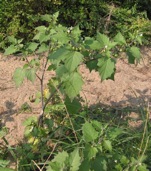
| Morphology: An erect or rambling, sparingly or often much branched glabrous herb that grows to a maximum of 0.5 m. Leaves are ovate-oblong, sinuate or toothed or lobed and narrow at both ends. Flowers are white in extra axillary dropping sub-umbellate cymes. Berries are red, yellow or black. Seeds are smooth and yellow in colour. |
| Distinguishing features: The plant can be distinguished, as it is an erect glabrous herb with toothed leaves and axillary dropping sub-umbellate cymes inflorescence. The fruits of the plant are of three colours, black, yellow and red indicating 3 different varieties. |
| Life cycle: Flowering takes place in June-August whereas fruiting takes place from August-October. |
| Uses: The herb has antiseptic and anti-dysenteric properties. It is given internally for neuralgia and gripe. An infusion of the plant is used as an enema for children having abdominal upsets. It is a household remedy for anthrax pustules and is applied locally. The plant also finds use as diuretic, emollient, laxative and its action is regarded as an antispasmodic and narcotic. It is also useful in cirrhosis of liver and antidote to opium poisoning. Decoction of the plant may be used for the treatment of ascites. Leaves are applied on wounds, sores and eczema. The roots are also used to treat piles and syphilis. In gout, rheumatism, dropsy, gonorrhoea, cough, splenic and hepatitic enlargement. Berries are considered to be a tonic, diuretic, cathartic and useful in anasarca and heart diseases. They are a domestic remedy for fever, diarrhoea, ulcer and eye trouble. The herb is an emollient, anti-inflammatory, expectorant, anodine, digestive, laxative and diuretic. The species is a cardio-tonic, depurative, febrifuge and sedative. The whole plant is a tonic. It is useful in rheumatism, swelling, cough, asthma, and bronchitis and also effective in cardiopathy, cough and wounds. The leaves are used as poultice for rheumatism and gout like joint pain and skin diseases. The plant is a rich source of solasodine and Vitamin B2, B3 and vitamin C. Almost all the plant parts are used as medicine and used both in traditional folk and modern medicines. |
|
| |
|
|
 |
|
| Family: Solanaceae |
| Common/local name: Black bightshade, Makoi, kakamchi, Bandakh |
| Trade name: Data not available |
|
|
|
| File Size:551.9931640625kb |
|
|
|
| |
| |
|
|


